
Learn How to Do Beatboxing with Simple Practise Beats
If you're wondering how to do beatboxing, you're not alone. I get this question almost every week from students, teachers, parents, and even total strangers at gigs. Some think it’s a hard skill. Some think it’s only for rappers.
But here’s the truth: anyone can learn beatboxing. All you need is your mouth, breath, a few simple sounds, and a bit of consistency.
At School of Beatbox, we’ve taught beatboxing to thousands of people, kids, adults, and even corporate teams. You don’t need a studio. You don’t need gear. Just patience, rhythm, and the right guidance. That’s what this blog is here for.
This blog is for that person. For you. If you've ever tapped a beat with your hands or hummed a bassline, you’ve already taken the first step.
Let’s walk through how you can learn beatboxing using simple practise beats, starting with the basic sounds like the kick drum, snare drum, and hi-hat.

‘Please note our site contains affiliate links. While we only recommend products that we believe in, we may benefit financially from any purchases you make.’
What is Beatboxing?
Beatboxing means using your mouth, tongue, lips, and voice to make rhythms. Most people use it to copy drum sounds.
Some take it even further and create full tracks with just their voice. The beauty of beatboxing is that it’s open to everyone. It lives inside you already. You just need to learn how to control it.
If you want to learn beatboxing, start with the basics. And I mean real basics. We’re not jumping to crazy fast routines. We’re building strong sounds, one at a time.
The Three Core Beatbox Sounds
Every beatboxer, no matter how advanced, uses these sounds:
These are called basic sounds for a reason. They form the skeleton of nearly every beat. Let’s break each one down.
Kick Drum (The "B" Sound)
This is your bass drum. It gives the beat its pulse. It’s often the first sound people try because it feels close to natural speech.
You don’t want to puff your cheeks. Keep everything compact. Try saying “boom” without using your vocal cords. That’s the vibe you’re after.
This sound lives at the front of your beat. It starts the groove.
Hi-Hat (The "T" or "Ts" Sound)
This is your timekeeper. It keeps the rhythm moving between the heavy hits.
Try this:
1. Place your tongue behind your top front teeth
2. Push a small burst of air
3. Say “t t t” or “ts ts ts” softly
Keep the sound short. No voice. No breathy sighs. It should feel sharp and fast. You can change it slightly to create closed or open hi-hats. Say “t” for closed. Say “ts” for open.
Once you get it right, you’ll find it fits between other sounds like glue.
Snare Drum (The "K" Sound)
The snare gives your beat the crack. It breaks the rhythm up. It’s often the trickiest of the three, but it’s worth the time.
To make a basic snare:
1. Pull your tongue toward the back of your mouth
2. Build pressure near the roof
3. Snap it down to make a “k” or “kah” sound
It might feel weak at first. That’s fine. Focus on placement and tightness. If you’re not getting a good snap, try changing the angle of your tongue or pushing from your throat.
Keep playing until one version sticks.
Your First Beatbox Pattern
Now that you know the basic sounds, let’s build your first pattern. We keep it easy. One of the most classic patterns is:
B T K T
You say the kick, hi-hat, snare, hi-hat in a loop. I’ve taught this pattern to 8-year-olds and to adults in corporate workshops. It works every time. The beat flows naturally. It trains your timing. It helps you focus on the transitions.
Don’t rush it. Say it slow. Say it clearly. Loop it. Keep your sounds tight. Every time you complete a loop without slipping, that’s progress.
Once it feels smooth, you can add more kicks or change the snare style. But not yet. First, get the groove right.
Daily Practise Schedule
You don’t need to spend an hour to get good. Ten minutes a day is enough at the start. Stick to a small routine. It keeps things light and consistent.
Here’s a basic practise layout:

I still follow this kind of plan when I warm up. Some days, I just loop the B T K T pattern while walking to work.
Fixing Common Beatboxing Mistakes

DjenTravell, CC BY-SA 4.0
Almost every beginner makes the same few mistakes. If you know what to look for, you can fix them fast.
Weak Kick Drum
If your kick drum sounds airy, check your lips. They might be too loose. You might be using too much air. The solution is easy. Tighten your lips. Use less breath. Focus on a short, clean burst. Practise with your hand in front of your mouth. You should feel a pop, not a breeze.
Snare Sounds Like a Cough
This usually means your tongue is too low. Or you’re using your voice without meaning to. Lift your tongue toward the roof. Snap it down. Try doing it while inhaling, too. That might give you more control. I’ve had students fix their snare just by switching to an inward version.
Hi-Hat Feels Sloppy
This one often comes from too much breath or noise. You don’t want a long “tshhhh.” You want a tight “ts.” Make the sound short. Place your tongue carefully. Use a mirror if you’re unsure. The best hi-hats are dry and crisp.
Running Out of Breath
If you feel winded, you might be using too much air in each sound. Beatboxing should not leave you out of breath. Practise nasal breathing. Inhale through your nose on hi-hats. Keep your chest relaxed. Let your diaphragm work. I’ve seen massive progress in students once they learn how to breathe smarter.
Losing Rhythm
Speed is tempting. Everyone wants to go fast. But going fast is useless without control. If your beats fall off time, slow down. Use a metronome. Count in your head. Tap your leg. Stay on time. Speed will come. Clarity should come first.
Level Up with Simple Variations
Once you feel solid with B T K T, try these ideas:
1. Double the kick: B T K T B B T K
2. Change the snare: use an inward K or PF snare
3. Add open hi-hats: swap “T” with “Ts”
4. Hum a bass tone under the pattern
Each one adds depth. Don’t do all of them at once. Pick one. Try it for a few days. Then try another. Exploring small changes is what keeps beatboxing fun.

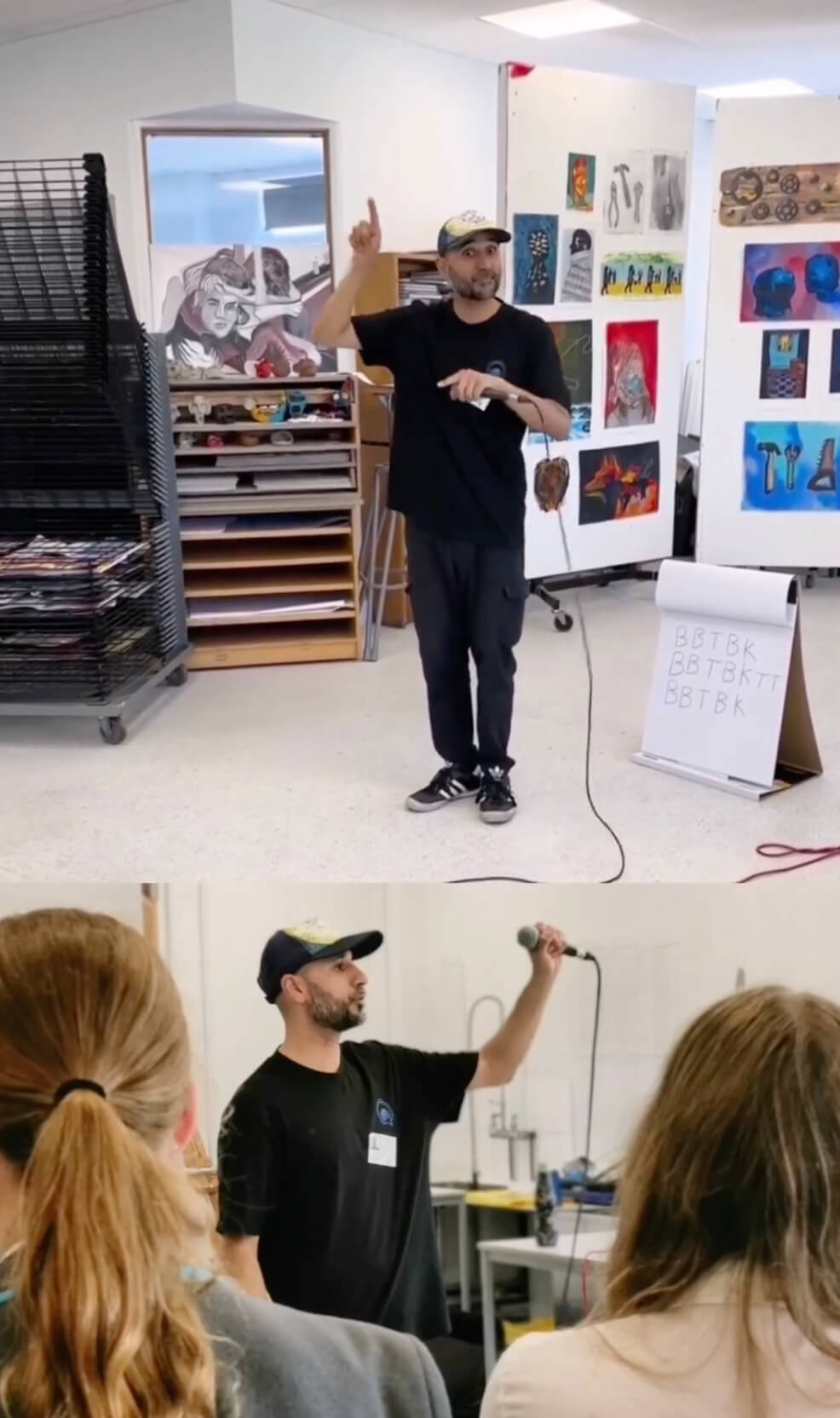
School workshop led by Danny Ladwa, founder of School of Beatbox.
What to Expect Over Time
Most beginners want to know how long it takes to get good. There’s no one answer. But here’s what I’ve seen.
If you practise ten minutes a day, you’ll feel the change in one week. Your sounds will sharpen. Your breath will feel more stable. Your rhythm will start to hold steady. After two or three weeks, your patterns will sound smoother. You might even start to freestyle without thinking.
After a month, you’ll start hearing beats everywhere. You’ll tap along to music. You’ll catch yourself beatboxing while doing chores. That’s when you know it’s clicking.
Beatboxing becomes part of your rhythm, not just in music but in your day.
Final Thoughts
You now know how to do beatboxing using the three basic sounds. You’ve learnt how to practise. You’ve seen the common mistakes. You know how to fix them. You’ve got patterns that are simple and fun.
Learning beatboxing is not about tricks. It’s about control. It’s about rhythm. It’s about finding your voice in a new way.
Keep your practise short. Keep your focus clear. Try one new thing each week. Share your beats. Teach a friend. Record yourself. Get feedback.
And if you ever want more guidance, we’re here at School of Beatbox. We teach lessons. We run workshops. We help people of all ages learn how to beatbox with confidence.
It starts with one sound. Then one beat. Then a whole new rhythm.
Ready to level up your beatboxing? Join a session or explore our online courses at School of Beatbox. Let’s build your sound together.

ONLINE BEATBOX COURSE
- Over 70+ Lessons
- Taught by Championship Beatboxers
- No Musical Background Needed
- Access to Beginner, Intermediate, and Pro Lessons
- New lessons regularly, PLUS get lifetime access
ESSENTIAL EQUIPMENT FOR BEATBOXING AT HOME
Find the best microphone, powered speaker, and loopstation for beatboxing at home—tailored to whether you're practicing, recording, performing, or doing a mix of all three.


More blog posts:

The Magic of Beatboxing at Thomley: A Session to Remember

Finding Harmony in the Virtual Workspace: How Beatboxing Energised ServiceNow’s Global Team
Unlock Your Voice: The Power of 1-to-1 Beatbox Lessons & Our Upcoming 4-Week Cohort
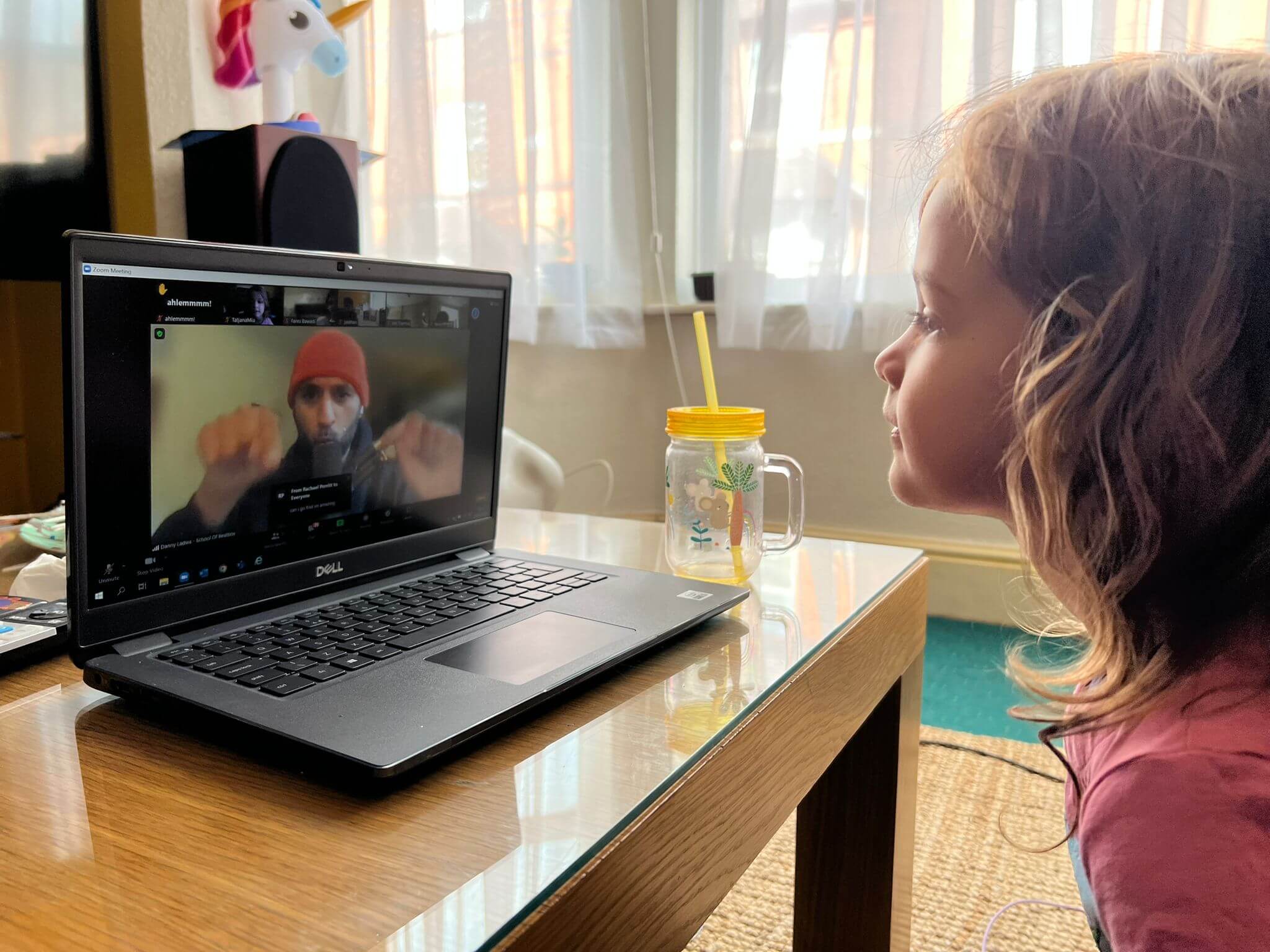
Dive into the World of Beatboxing: Online Beatbox Classes for Children Are Back!

SCHOOL OF BEATBOX HIGHLIGHTS SUMMER 2024
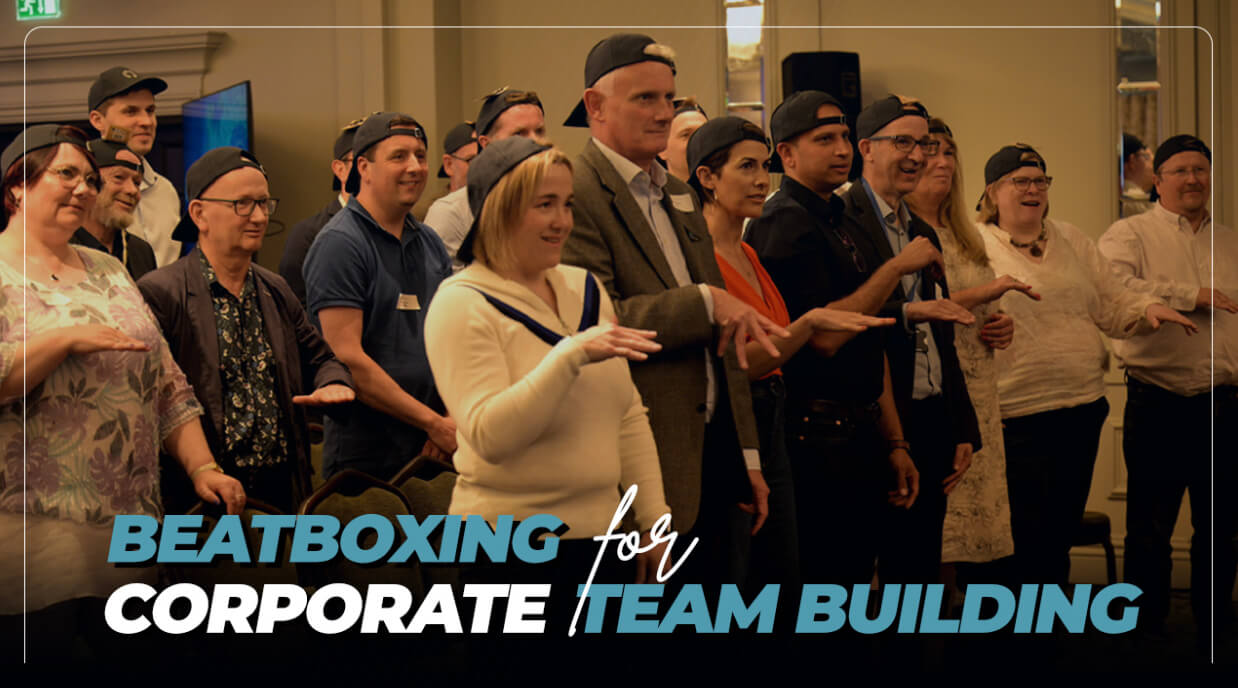
How Beatboxing Brought Computacenter Teams Together
"How to Make Your Beatboxing Sound Like a Real Drummer: Mastering Hi-Hat Dynamics"
Exploring Portland's Weirdness Through Haiku and Beatboxing: A Unique Creative Collaboration
Book A Private 1-to-1 Lesson! - (online)
I've been teaching beatboxing to people aged 5yrs to 73yrs (no joke) for 20 years. Whatever you are looking to achieve I'm sure I either have the right method or I can find the right method to get you there. Whether you're a complete beginner or have some beatboxing experience, these private online 1:1 lessons will be tailored to suit you and ensure you progress in this wonderful art form.
ONLINE BEATBOX COURSE
- Beatbox Pro has over 70+ Lessons
- Taught by Championship Beatboxers
- No Musical Background Needed
- Access to Beginner, Intermediate, and Pro Lessons
- New lessons regularly, PLUS get lifetime access
mail@schoolofbeatbox.com
6 Mcburney Court, 2 Newsholme Drive, London, N21 1UD
9am - 5pm GMT Mon - Sat